A Journey of Connection: Returning to My Roots and Serving the Deaf and Hard-of-Hearing Community in Africa
|
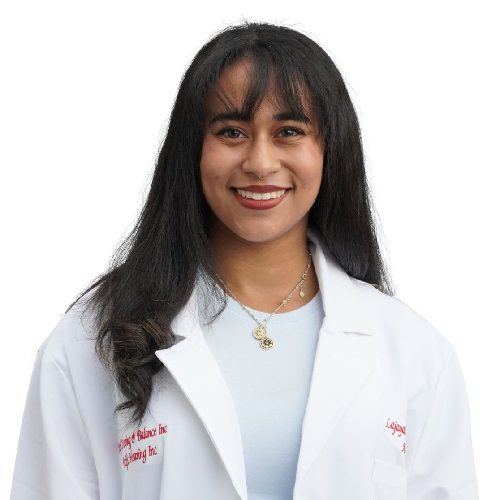
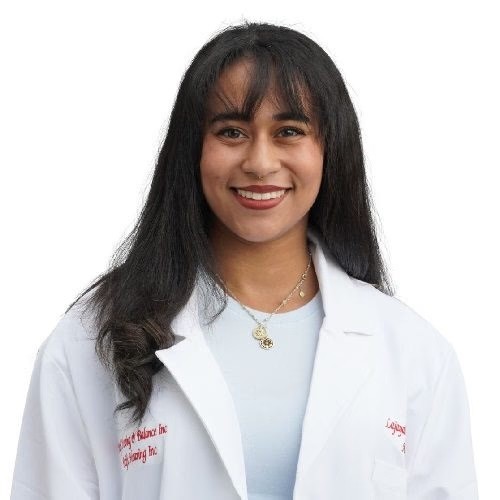
Lajayah Medina
|
May 5, 2026
Last summer, I traveled to Lebanon to assist the community with hearing healthcare through DeafDefy, which focuses on providing life-changing care for Deaf and hard-of-hearing individuals across the world.
This July, I will be embarking on my next medical mission, traveling to Kenya and Ghana, where I will have the honor of serving the Ghanaian community during my time in Africa.
I cannot put into words how excited I am!
This journey is deeply personal for me; as a Black Mexican American, I can trace my roots back to West Africa. This isn’t just a trip to me: It feels like a return, a purpose being fulfilled.
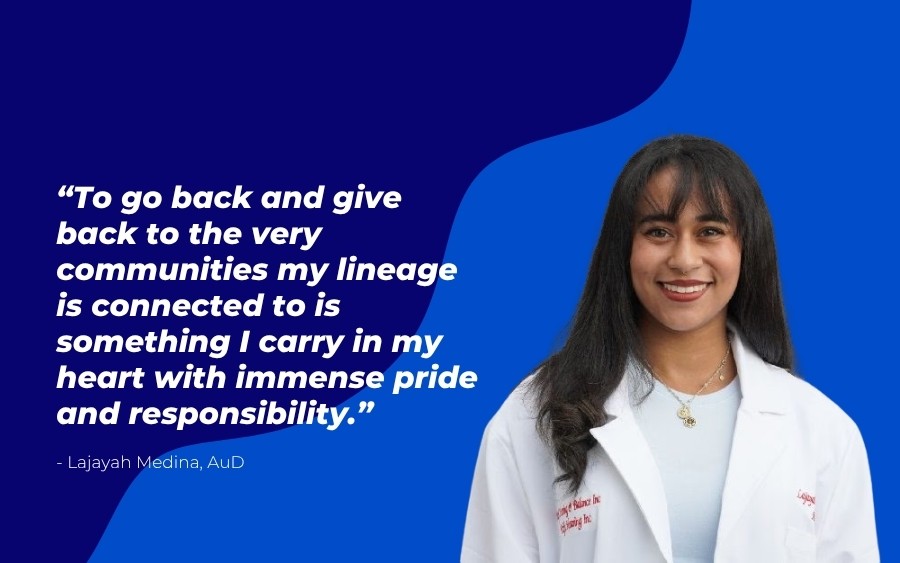
To go back and give back to the very communities my lineage is connected to is something I carry in my heart with immense pride and responsibility.
The Need for Care Is Real
Across Africa, the need for accessible audiological care is profound and urgent:
More than 40 million people are currently living with hearing loss across the continent
This number is projected to rise to 54 million by 2030 if interventions are not made (World Health Organization)
Over 75 percent of countries have fewer than one audiologist per million people (American Academy of Audiology)
Hearing loss is not only widespread, but often preventable and treatable, yet so many go without the care they deserve (Mulwafu et al.).
From Lebanon to Africa: The Mission Continues
My journey into global health began in 2025, when I was invited to join DeafDefy on a mission to Lebanon.
DeafDefy is an organization that empowers Deaf and hard-of-hearing (DHH) youth through mentorship, education, and career development opportunities. Their work focuses on breaking down barriers and building confidence so DHH individuals can thrive in school, the workplace, and leadership roles.
DeafDefy’s impact comes to life through dedicated teams, led by founder Zaineb Abdulla and made up of language specialists, interpreters, and audiologists, who travel to underserved communities across the Middle East and Africa. There, they provide hearing exams, distribute hearing aids, and introduce regionally relevant sign language.
What I Saw in Lebanon
My time in Lebanon was beyond compare. As an audiologist in the United States, I most often encounter presbycusis (age-related hearing loss). What I witnessed in Lebanon was entirely different.
The children I met were living in silence in a way that shaped every part of their world. Many struggled to communicate even with their own families.
Some had been exposed to bombings, others were displaced from their homes, and many had treatable ear conditions that, due to compounding health issues and lack of access to care, had slipped away.
Yet, in the middle of all of this, there was resilience, warmth, and hope. Watching a child respond to sound for the first time, or seeing a parent begin to communicate with their child in a new way, is something I will carry with me forever.
I can’t wait to make even more of a difference this summer in Kenya and Ghana!
Representation and Equity in Healthcare
As I step into the field of audiology, a profession that is 97 percent white, I am constantly reminded how important representation is. Diversity in healthcare is not optional; it is essential.
Seeing providers who look like you and who understand your culture, your story, and your lived experience builds trust and connection, and it ultimately changes outcomes.
This mission is bigger than me. It’s about service, equity, and showing up for communities that have been overlooked and underserved.
I am beyond grateful for the opportunity to use my hands, my knowledge, and my heart to serve. Providing access to hearing means providing access to connection, to family, to education, to opportunity, and to life itself.
And for me, the most powerful part of it all? I get to serve my people.
This journey is only the beginning. I am so grateful that I can give back to this community as an audiologist, bringing joy by helping others find connection in ways that are so often taken for granted.
Sources
World Health Organization. Burden of Hearing Loss in Africa Could Rise to 54 Million by 2030. WHO Regional Office for Africa, 2023.
American Academy of Audiology. Hearing Loss on the Rise in Africa. American Academy of Audiology, 2021.
Mulwafu, Wakisa, et al. “Prevalence and Causes of Hearing Impairment in Africa.” Tropical Medicine & International Health, vol. 21, no. 2, 2016, pp. 158–165.